Superior investing is not about finding good assets — it's about finding good assets at prices below their value.
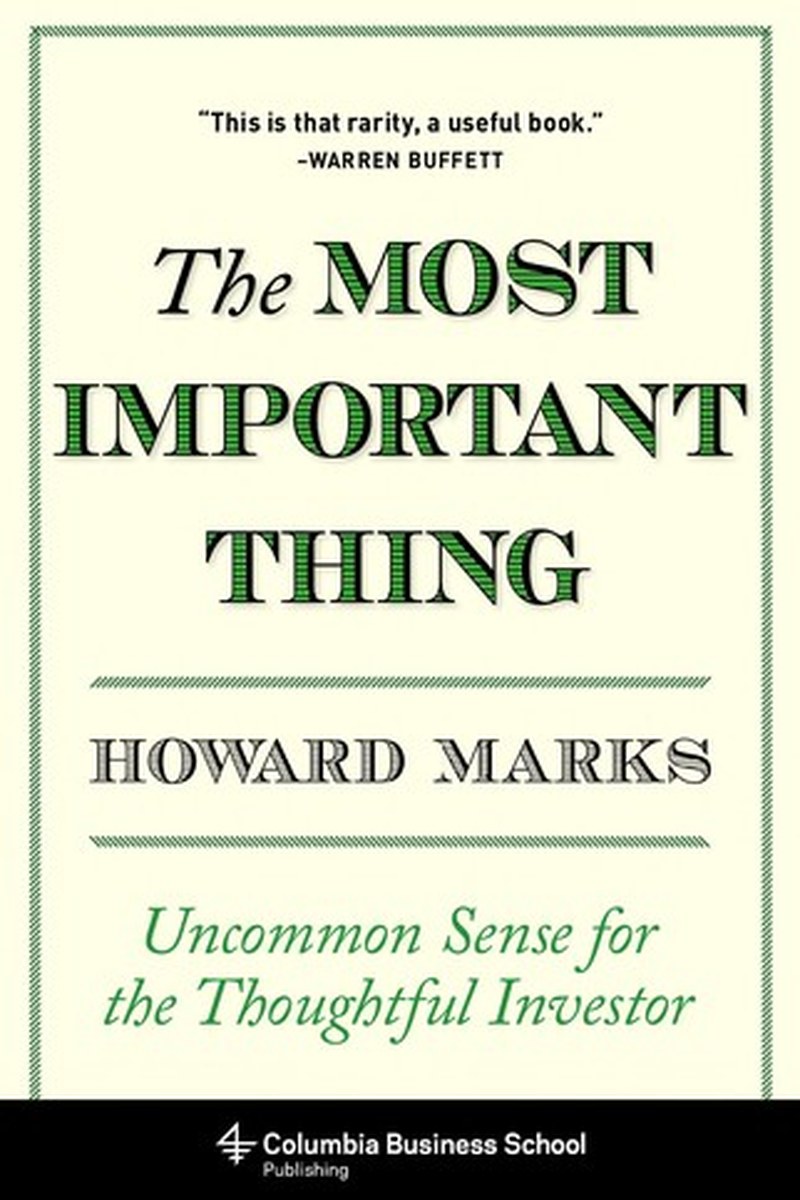
The short version: a quick read to help you decide. Not a replacement for the book.
Howard Marks distills decades of thinking into a framework for what separates great investors from average ones.
Most investors think at the first level. Superior investors think at the second level — asking not just what is true, but what is true relative to what the market already believes.
1. Risk is not volatility — it is the probability of permanent loss.
A great asset that temporarily drops in price is an opportunity, not risk.
2. You can't know the future — but you can know where you stand in the cycle.
Assess whether conditions are tilted toward greed or fear.
3. The most dangerous thing is believing something is "safe."
The crowd's consensus on safety is almost always wrong at the extremes.
4. Avoiding losses is more important than achieving gains.
A 50% loss requires a 100% gain just to get back to zero.
5. Luck plays a larger role than most investors admit.
Evaluate decisions on process rather than outcome.
Investors who want to develop the mental frameworks that produce genuinely superior long-term results.
Principle: Marks argues that investing is not about identifying good assets, but about identifying assets priced below their worth. Price, not quality, determines return.
The action: Pick one holding you own or are considering. Write a single paragraph stating what the current price implies the market believes about its future. Then state where you disagree, and why.
Principle: Marks does not attempt to forecast markets, but he does insist on knowing where we stand in a cycle. Investor psychology is the most reliable indicator available.
The action: Once a month, answer three questions in writing. Are people around me greedy or fearful? Is credit easy or tight? Are bad businesses being funded? Keep the answers in one running document.
Principle: Marks's central asymmetry is that avoiding losses matters more than capturing gains, because compounding is destroyed by drawdowns far more than it is helped by outperformance.
The action: Before your next investment, write the realistic worst case in money terms — not percentage terms. State plainly whether you could absorb it without changing your life.
Principle: Marks warns that a good outcome does not prove a good decision. In a probabilistic field, results are a poor guide to process quality.
The action: Review your three most recent financial decisions. For each, judge the decision quality on the information available at the time, independently of how it turned out.
Principle: Marks's concept of second-level thinking requires holding a view different from the consensus and being right about it. Comfortable positions rarely produce superior returns.
The action: Identify one position where you currently agree with everyone around you. Write the strongest possible case against it. Decide whether your conviction survives the exercise.
Review monthly. The goal is not to predict markets but to know where you are within them, and to size your positions so that being wrong is survivable.