Einstein's own short book for non-specialists on why time and space depend on who is measuring, and why gravity bends them.
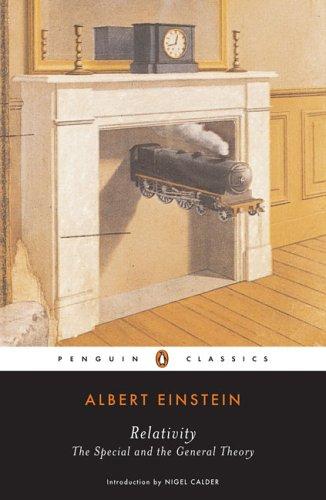
The short version: a quick read to help you decide. Not a replacement for the book.
Einstein wrote this short book in 1916 for readers without a physics degree. It walks through special and general relativity in plain language, using thought experiments about trains, lifts and light. The ideas changed physics, and the way he reasons is worth learning on its own.
There is no single universal clock. Whether two events are simultaneous depends on the observer, because the speed of light is the same for everyone. General relativity then adds that gravity is the bending of space and time by mass.
1. Question what looks obvious.
The idea of one absolute time seemed beyond doubt until Einstein tested it. The big gains often come from re-examining the assumption nobody checks.
2. Reason with thought experiments.
Much of the book works through imagined situations, like a moving train or a lift in space. A well-chosen scenario can show a contradiction you would not spot in abstract terms.
3. Start from a few firm principles.
Special relativity rests on two simple postulates, and everything else follows from them. Clear foundations beat a pile of special cases.
4. Your point of view is part of the data.
Observers moving differently can disagree about time and distance and both be right. Knowing where someone is standing is part of understanding what they report.
5. Check theory against the world.
General relativity predicted that starlight would bend near the sun. That prediction could be tested, and it was. A good idea is one that could be proven wrong.
Curious readers who want the main ideas from the source in Einstein's own words. It needs only school-level maths, though some passages take a slow, careful read.
Principle: A well-chosen imagined scenario can expose what abstract thinking misses.
The action: Take a problem you are stuck on and imagine one extreme version of it. Write what it shows you.
Principle: Big gains come from checking what everyone takes for granted.
The action: List three assumptions behind a decision you are facing. Pick the one you have never checked and find evidence for or against it.
Principle: Observers in different positions can disagree and both be right.
The action: Describe a disagreement from the other person's position, including what they can see that you cannot.
Principle: If you cannot say it simply, you do not yet understand it.
The action: Explain the core idea of relativity in three sentences to someone who has not read the book.
Principle: A good idea can be proven wrong.
Complete steps 1–4 first.
The action: Pick one belief you hold strongly. Write what you would expect to see if it were true and what would show it false, then look for it.