Homo sapiens didn't rise to dominate the planet through individual strength or intelligence alone — we rose because we're uniquely able to believe in shared fictions, at scale, together.
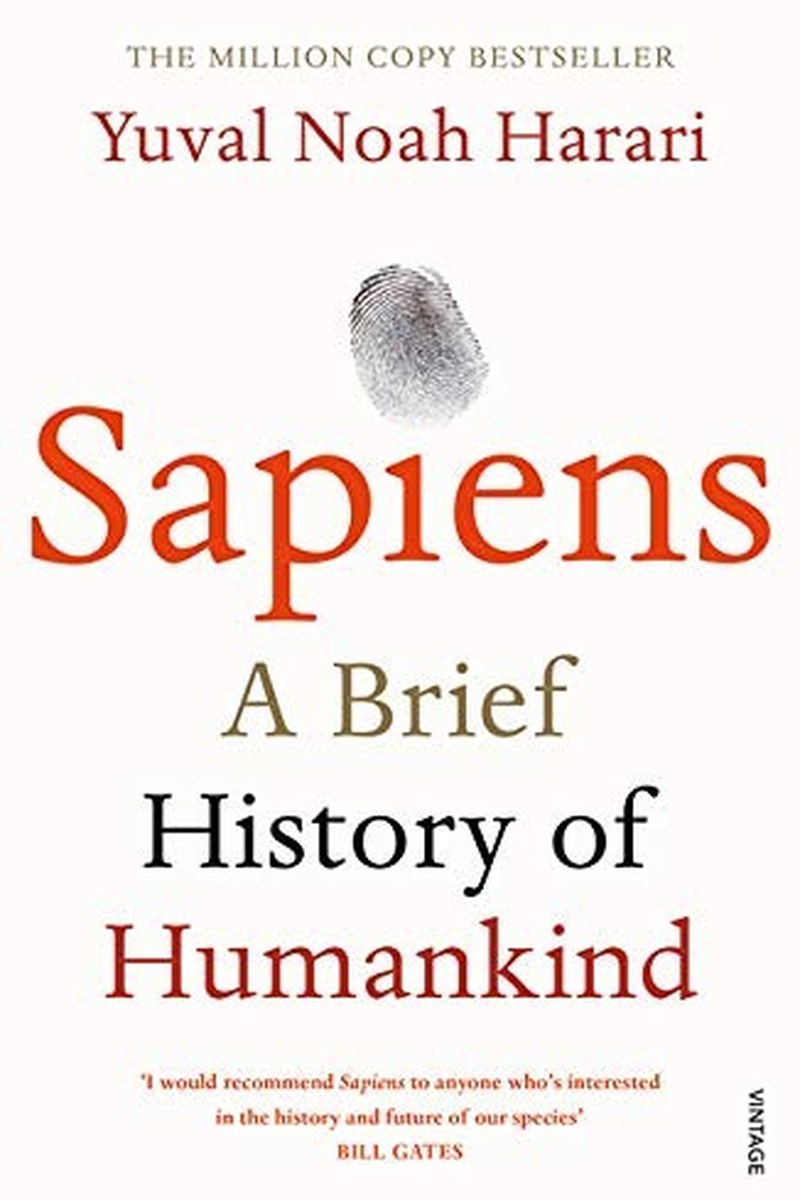
The short version: a quick read to help you decide. Not a replacement for the book.
Harari compresses roughly 300,000 years of human history into a single sweeping narrative, reframing agriculture, money, empire, and religion as consequences of one underlying human capability.
The Cognitive Revolution — the ability to create and believe in shared fictions — allows strangers to cooperate in the millions. Everything since flows from this capacity.
1. Shared fictions, not just genes, built human civilization.
Money, nations, and corporations coordinate massive cooperation despite not existing outside collective belief.
2. The Agricultural Revolution was, in some ways, a trap.
Farming often meant harder labor and worse nutrition, but enabled population growth that locked humanity in.
3. Money is the most universal and successful shared fiction ever created.
It bridges cultures that agree on almost nothing else.
4. Empires and religions succeed by being genuinely universalizing.
The most durable large-scale systems claim to apply to all people.
5. The Scientific Revolution began with an admission of ignorance.
Acknowledging what we don't know paradoxically unlocked unprecedented progress.
Readers who want a big-picture, myth-busting framework for understanding how human societies came to cooperate at scale.
Principle: Shared fictions built human civilization.
The action: Identify one "fiction" that shapes your daily decisions and write why it works.
Principle: The Agricultural Revolution was, in some ways, a trap.
The action: Identify one "upgrade" that may have added complexity without improving wellbeing.
Principle: Money is a universal shared fiction.
The action: Pick a system you rely on and write what would happen if collective trust broke down.
Principle: The most durable systems claim to be for everyone.
The action: Identify an organization you're part of that claims universal relevance.
Principle: Science began with an admission of ignorance.
The action: Identify an area where you've been assuming certainty.