Strategy isn't a plan or mission statement — it's a set of five interlocking choices.
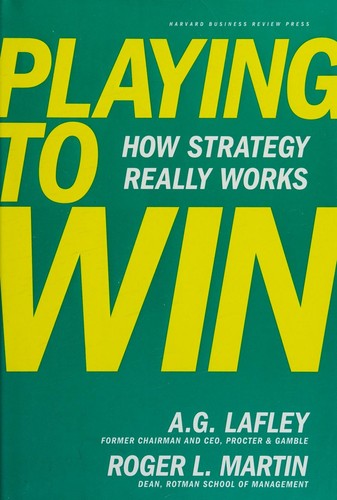
The short version: a quick read to help you decide. Not a replacement for the book.
Turns "strategy" into a concrete, testable framework used to turn around P&G.
Real strategy answers five cascading questions: winning aspiration, where to play, how to win, capabilities, management systems.
1. Strategy is choice, and choice means saying no.
If a strategy doesn't rule anything out, it isn't a strategy.
2. "Where to play" is as important as "how to win."
The right arena determines whether your advantages matter.
3. Competitive advantage must be specific, not generic.
Say precisely why competitors can't copy it.
4. Capabilities and management systems must match the strategy.
Not the other way around.
5. Test your strategy like a hypothesis.
Ask what would have to be true, then find evidence.
Founders and executives who want a rigorous framework for strategic choices.
Principle: Strategy starts with what winning means.
The action: Write one sentence defining what winning looks like.
Principle: Where to play matters as much as how to win.
The action: Name the specific market or segment you'll focus on.
Principle: Advantage must be specific, not generic.
The action: Write why competitors can't copy your advantage.
Principle: Capabilities must match the strategy.
The action: List the 3 most critical capabilities and gaps.
Principle: Ask what would have to be true.
Complete steps 1–4 first.
The action: List conditions for success and gather evidence.